



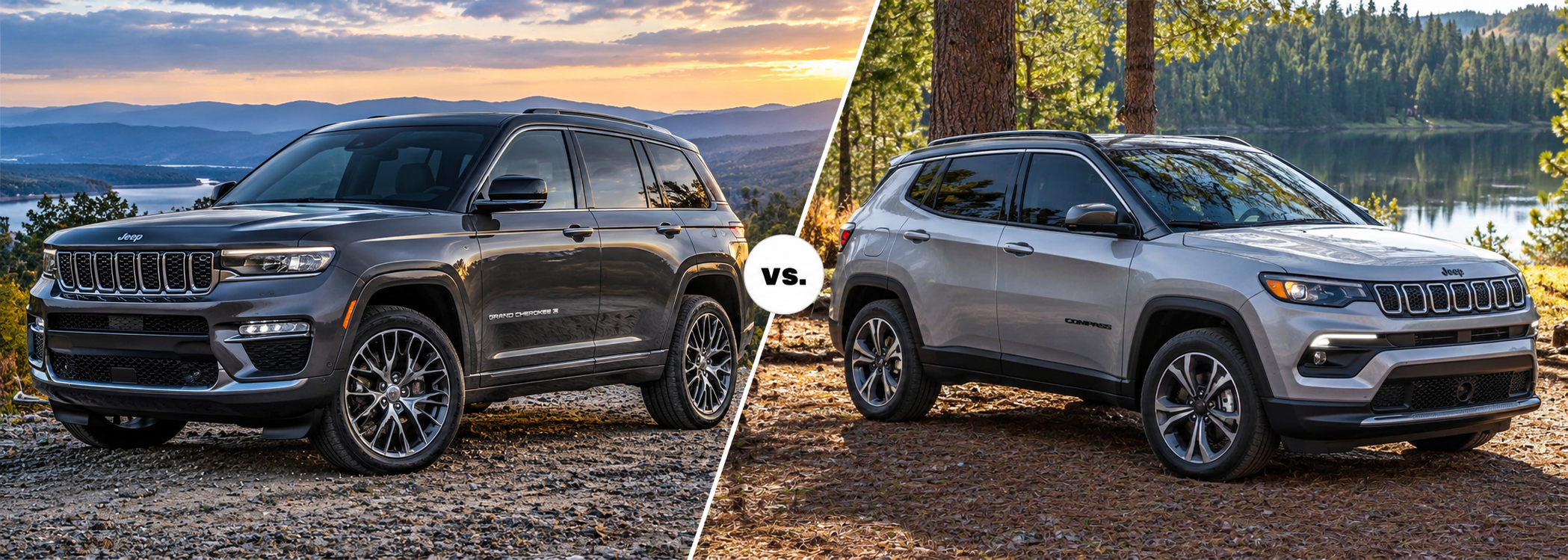
Jeep Compass vs. Grand Cherokee: How Much SUV Do You Need?
Two Jeeps, Two Different East Texas Lives
What the Jeep Compass Delivers
The Compass is a compact SUV that does exactly what most solo drivers and small families need it to do. It is easier to park on Livingston's city streets, more efficient on daily runs down US-59 and US-190, and meaningfully less expensive to own month to month. The Compass Trailhawk trim carries a Trail Rated badge and adds a locking rear differential, front tow hooks, and improved ground clearance for drivers who occasionally leave the pavement.
The available Compass 4xe plug-in hybrid is worth calling out specifically for Polk County commuters. It provides electric-only driving range for short daily runs, then switches seamlessly to gasoline power—reducing fuel costs significantly for buyers who drive predictable daily routes between Livingston, Corrigan, or Woodville.
Where the Compass has a hard limit: towing. Its maximum towing capacity is 2,000 pounds—enough for a personal watercraft or a small utility trailer, but nowhere near enough for the bass boats, horse trailers, and bumper-pull campers common across East Texas.
What the Grand Cherokee Delivers
The Grand Cherokee is a midsize SUV with a completely different capability profile. Its 2.0-liter Hurricane Turbocharged engine produces 324 horsepower on Altitude and higher trims, giving it nearly twice the engine output of the base Compass. Maximum towing reaches 6,200 pounds—enough to handle a large bass boat on Lake Livingston, a loaded utility trailer, or a small camper without strain.
The available Quadra-Drive II 4WD system with a rear electronic locking differential gives the Grand Cherokee a genuine off-road edge for hunters and anglers accessing remote East Texas forest service roads. The returning Overland trim adds air suspension and an aggressive front fascia for buyers who want serious trail capability alongside premium interior comfort.
For families who need a third row, the Grand Cherokee L extends the platform to seat seven passengers across three rows in a 204.9-inch body -- one of the few midsize options with genuinely usable adult rear-row legroom.
The Numbers That Matter Most
Engine: Compass -- 2.0L Turbo 4-cylinder, 200 hp | Grand Cherokee -- 2.0L Hurricane Turbo 4, 324 hp
Maximum Towing: Compass -- 2,000 lb | Grand Cherokee -- 6,200 lb
Cargo Space (behind 2nd row): Compass -- 27.2 cu ft | Grand Cherokee -- 37.7 cu ft
4WD System: Compass -- Selec-Terrain AWD | Grand Cherokee -- Quadra-Trac II or Quadra-Drive II
Passenger Capacity: Compass -- 5 | Grand Cherokee -- 5 standard, 7 with Grand Cherokee L
Starting MSRP: Compass -- approximately $28,000 | Grand Cherokee -- approximately $41,000
Who Should Choose the Compass
If you commute daily with one or two passengers, rarely tow anything heavier than a jet ski or a small utility trailer, and want to minimize monthly vehicle costs, the Compass is the smarter buy. It covers Polk County's daily driving needs without the added fuel, insurance, and registration costs of a larger vehicle. The 4xe plug-in hybrid makes this case even stronger for commuters with predictable daily routes.
Who Should Choose the Grand Cherokee
If you regularly carry four or five passengers, own a boat or camper, haul equipment trailers for work, or want a more powerful, premium-feeling daily driver that still handles whatever East Texas terrain puts in front of it, the Grand Cherokee is the right call. And if seating seven is a requirement, the Grand Cherokee L is the direct answer. No compact SUV in the Jeep lineup can replicate its three-row practicality or its 6,200-pound towing capacity.
Come See Both at Kramer CDJR Livingston
The best way to decide is to sit in both back-to-back. Visit Kramer CDJR Livingston to test drive the Compass and Grand Cherokee on the same trip and feel the size, power, and comfort differences firsthand. Browse our current inventory at kramerchryslerdodgejeepram.com or contact our team to schedule a visit. We serve Polk County and all of East Texas.